PX-01 / GOLDWORK
The gold ewer & salver
A tall vessel beside a broad, shallow dish
 PAXERUNITHE ROYAL CABINET
Six paintings.
Many ways to look.
COLLECTION 01 / THE ART OF ATTENTION
A royal cabinet of gold, jewels and imagined histories. Come closer. There is more than one way to see a treasure.
Open the cabinet ↗PX—01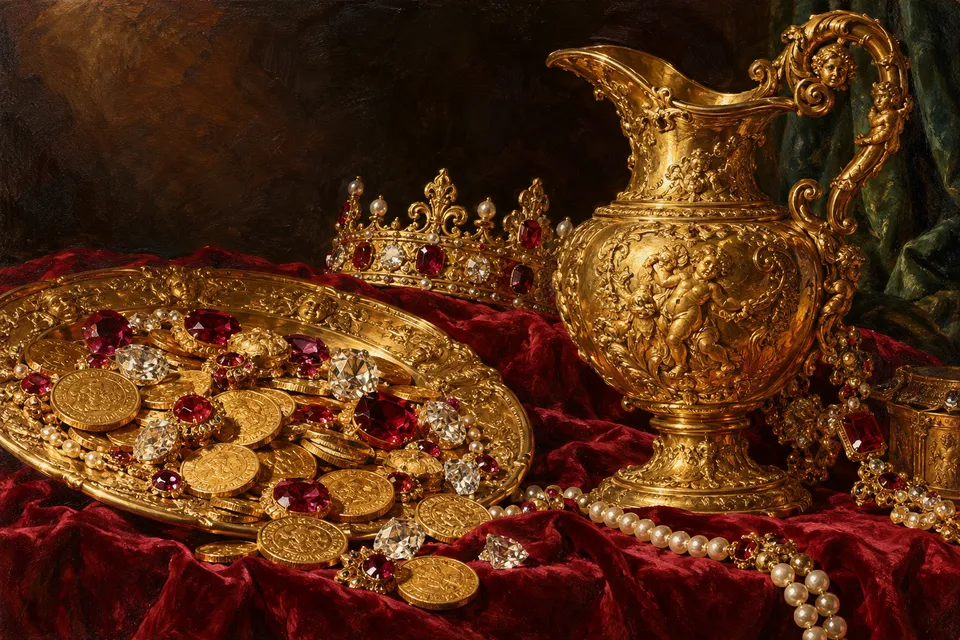
A NOTE FROM THE CABINET
Not every treasure asks to be counted. Some ask you to follow the edge of a handle, the fall of a cloth or a thread of light across a stone. This collection is an invitation to practise that kind of attention.
THE CATALOGUE
Filter by family, search a material, then bring up to three objects together. Their differences are often the most interesting part.
6 objects shown
PX-01 / GOLDWORK
A tall vessel beside a broad, shallow dish
PX-02 / GOLDWORK
A spiral shell held in an elaborate gold mount
PX-03 / JEWELLERY
An oval pendant with a looping chain
PX-04 / MECHANISMS
An open watch, an hourglass and a winding key
PX-05 / CABINET
Drawers, a small crown and a brooch
PX-06 / MECHANISMS
A long key beside a small engraved seal
No objects match this search. Try a shorter word or reset the filters.
A SMALL EXHIBITION OF YOUR OWN
Choose up to three objects to compare.
Selections and notes stay in this page. Download a copy before leaving; nothing is sent to a server.
OBJECT STUDY / PX—03
A jewel can anchor an entire painting. Here, the pendant’s weight is answered by the restless path of its chain.
THREE WAYS A SURFACE SPEAKS
A small, sharp highlight makes a diamond appear much brighter than the cloth beside it. The dark setting gives that light its force.
Gold spreads warmth across a larger shape. Notice how a broad passage of paint can describe a curved vessel before the ornament begins.
Velvet gathers shadow into its creases. Those darker channels slow the eye and give the hard objects a softer setting.
AN OBJECT WITH TWO VOICES
The nautilus cup pairs a broad pearly shell with a dense gold mount. One surface asks for a long, quiet look; the other invites the eye to keep moving.
FROM THE STUDY ROOM / PX—05
A crown, a brooch, a few papers and a carved piece share the same warm worktable. Daylight changes the mood of the collection without changing its subject.
The scene remains imagined. There are no invented dates, excavation stories or ownership records attached to these objects.
A PAUSE IN THE GALLERY
PX—04 / THE TIMEKEEPER’S COMPANY
The watch gives a moment a face. The hourglass gives duration a shape. In a still painting, neither needs to move for us to recognise the idea.
Compare the round dial with the narrow glass vessel. Then notice the small winding key: a modest object beside two elaborate ones.
Read about making connections ↗THE QUIETEST OBJECT / PX—06
The most ornate part of this key is the part held in a hand. Its long dark shaft gives the golden crown-shaped bow room to be noticed.
Inspect the key and seal ↗A ROUTE THROUGH THE PICTURES
Silhouette comes before ornament. Describe it without naming the object.
Where does light gather? What dark shape helps you notice it?
Put two objects together in the curator’s tray. Write one similarity and one difference.
BEFORE YOU GO
No. Paxeruni is a fictional digital collection. The paintings are created illustrations, and catalogue numbers are navigation labels, not evidence of provenance.
Yes. Add one to three objects to your tray, write an observation and download the note. It is a text file on your device. Your selection is not saved to an account or sent to a server.
No. Material words describe the visual story of an imagined scene. The paintings are not tests of authenticity, condition, origin or value.
THE VISITOR’S BOOK
Send an observation, ask a question or tell us if something is difficult to use.