
01 / SHAPES
Describe the outline
before the name.
A tall vessel, a broad dish, a narrow shaft, a loop. Simple words help separate the structure of an object from the associations its name brings. The ewer and salver share a material, but make very different shapes.
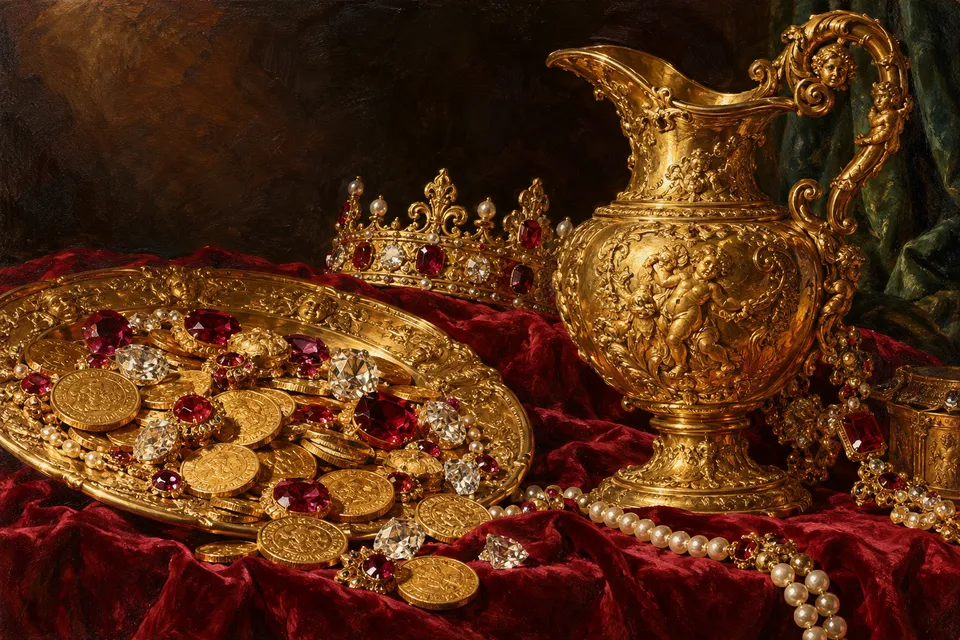
Try it: Choose an object and describe its outline in five words. Leave out the name and any guess about its history.
02 / SURFACES
Find a hard edge
and a soft one.
The paintings contrast sharp jewel facets with cloth that falls into shadow. Gold can sit between them: its silhouette may be crisp while light spreads smoothly across a curved part.
The images are digitally created in an oil-painting-inspired manner. Brush-like marks and glazes are part of their appearance; they do not prove a physical canvas, a particular artist or a historic technique.
Try it: Look at the pendant. Find the brightest diamond, then the darkest fold beside it. Describe the difference without using the word beautiful.
03 / CONNECTIONS
Give the object
a companion.
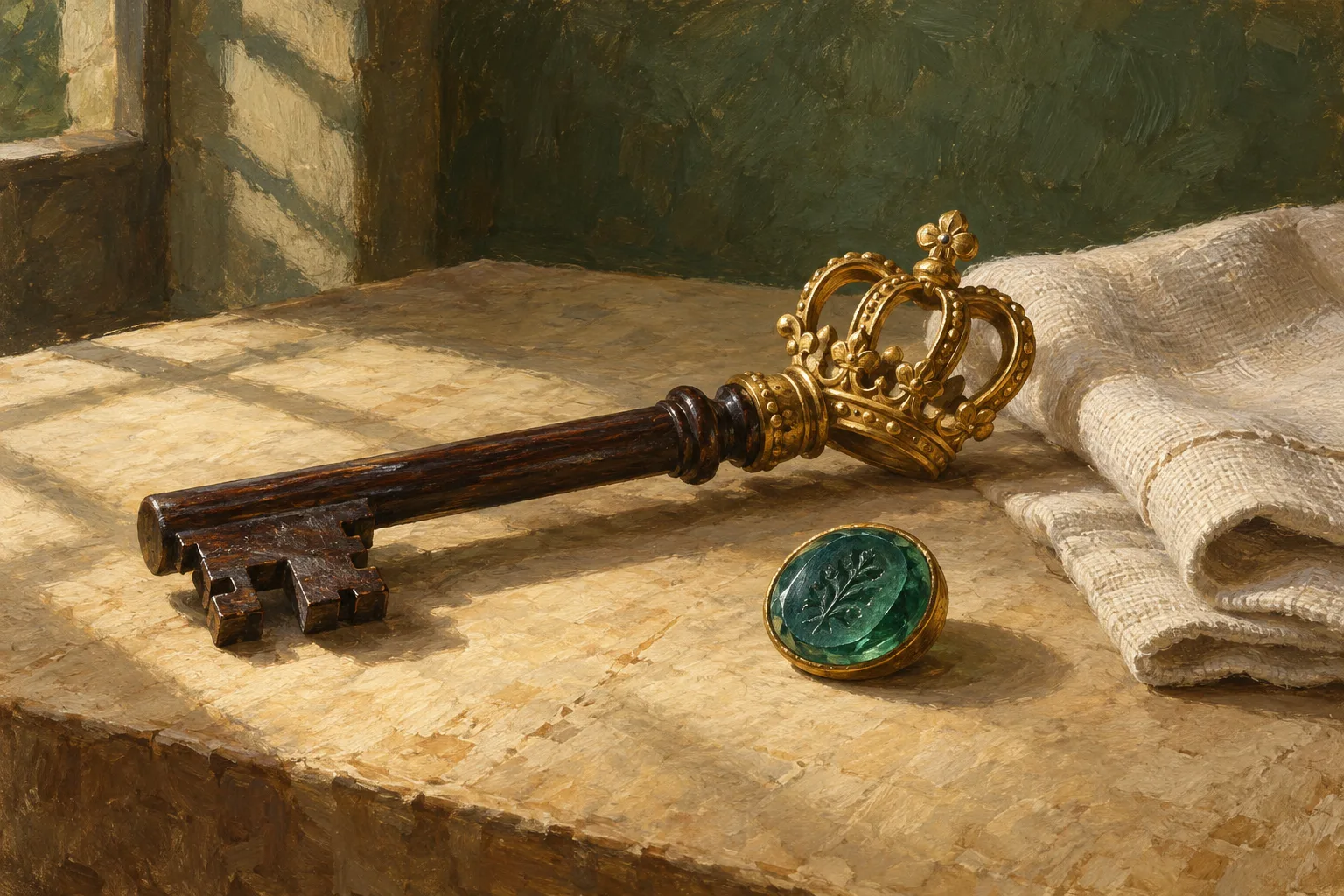
A key and a watch may suggest mechanisms. A cup and an ewer may suggest vessels. A less obvious pairing can be more revealing: compare the key’s long shaft with the pendant’s wandering chain.
Use the curator’s tray to keep two or three descriptions together. Its categories are a starting point, not the only possible way to group the pictures.
Arrange your own tray ↗04 / WORDS
Write what you see.
Then what you wonder.
Keep observation and interpretation separate. “A red stone sits below a gold loop” describes the image. “It might have been a gift” is an imagined possibility. Neither needs to pretend to be a verified historical fact.
Try it: Write two sentences in your tray note. Begin the first with “I notice…” and the second with “I wonder…”.
05 / LIMITS
A picture is not
a provenance record.
Catalogue numbers on this site organise an imaginary collection. They are not evidence of a maker, owner, date, excavation or sale. Material descriptions serve the artwork’s visual story and cannot identify a real gemstone or establish its value.
Those limits leave plenty to explore: colour, light, scale, rhythm and the relationship between objects. A careful description is worthwhile without an invented certificate.